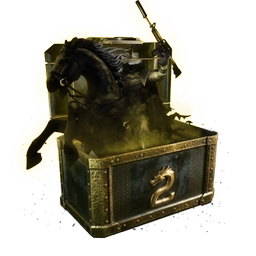
Counter-Strike 2 (CS2) has inherited not just the legacy of Global Offensive, but also its deeply ingrained, multi-million dollar virtual economy. At the heart of this economy lie CS2 cases. For millions of players, the sound of a case spinning and the golden flash of a rare item represent the ultimate thrill.
Whether one is a seasoned trader or a curious newcomer, understanding how CS2 cases work is essential for navigating the game’s marketplace. This comprehensive guide explores everything from drop mechanics and odds to opening strategies and market economics.
What Are CS2 Cases?
CS2 cases are virtual container items that hold weapon finishes (skins), gloves, or knives. To open a case, players need two things:
- The Case Itself: Obtained through random drops or purchased from the Steam Community Market.
- A Weapon Case Key: Purchased directly in-game for £2.50 GBP (or regional equivalent).
Once opened, the case is consumed, and the player receives a single cosmetic item determined by randomized probabilities.
How to Get CS2 Cases
Players do not need to spend money just to get their hands on cases. Valve provides several methods for acquiring them through active play.
Methods of Acquisition
- Weekly Care Package: Every week, upon ranking up for the first time, players receive a care package where they can choose two out of four randomized items (typically a mix of graffiti, cheap skins, and cases).
- Idle Servers: Some players leave their games running on dedicated idle servers, hoping to receive passive drops.
- The Steam Community Market: The most reliable way to get a specific case instantly. Prices range from a few cents to hundreds of dollars for discontinued items.
- In-Game Drops: Playing on official Valve servers grants random drops at the end of matches (usually up to 3-4 drops per week, reset on Wednesday nights).
The Mathematics of Case Openings: Odds and Probabilities
Before diving into case openings, it is crucial to understand the house edge. Valve officially publishes the drop rates for container items in regions where it is legally required.
The standard rarity distribution for a normal weapon case is detailed below:
| Item Rarity Tier | Color Code | Approximate Drop Rate |
|---|---|---|
| Mil-Spec (Base) | Blue | ~79.92% |
| Restricted | Purple | ~15.98% |
| Classified | Pink | ~3.20% |
| Covert (Top Tier) | Red | ~0.64% |
| Special Item (Knife / Gloves) | Gold | ~0.26% |
What Does This Mean for the Player?
Statistically, out of every 400 cases opened, only one is expected to yield a Gold item (Knife or Gloves). Because keys cost £2.50, opening 400 cases requires an investment of £1,000, with no guarantee that the resulting knife will be worth anywhere near that amount.
Active vs. Rare Case Pools
Valve categorizes weapon cases into two distinct pools, which drastically affects supply and price.
1. The Active Drop Pool
These are cases currently dropping to players actively playing on Valve servers. Because supply is constantly generated, these cases are usually cheap (ranging from £0.10 to £1.50).
- Examples: Kilowatt Case, Recoil Case, Dreams & Nightmares Case.
2. The Rare (Discontinued) Pool
When Valve introduces a new case, older cases are moved to the “rare drop pool.” They drop extremely rarely (roughly 1% of the time a normal drop occurs). Because supply is fixed while demand fluctuates, these cases appreciate in value over time.
- Examples: Operation Bravo Case, Huntsman Weapon Case, CS:GO Weapon Case 3.
Case Opening Strategies: To Open or Not to Open?
From a purely financial standpoint, opening cases is a negative-expected-value proposition. The vast majority of items unboxed are worth significantly less than the £2.50 key used to open them.
However, players continue to open cases for entertainment, content creation, and the rush of hitting a rare drop. For those who choose to participate, consider the following best practices:
- Set a Budget: Treat case openings like going to a casino. Only spend money that you can afford to lose completely.
- Buy Singles Instead: If there is a specific skin you want, buying it directly from the Steam Community Market or third-party marketplaces is almost always cheaper than trying to unbox it.
- Invest Wisely: Many players prefer to buy and hold cases from the rare pool as an investment rather than opening them, relying on the historical appreciation of virtual commodities.
Frequently Asked Questions (FAQ)
Can you get knives from cheap cases?
Yes. Every standard weapon case containing a knife has the same ~0.26% chance of dropping a knife, regardless of whether the case costs £0.10 or £50.00. However, the specific pool of available knives differs per case.
Do CS2 cases expire?
No. Cases do not have an expiration date. They will remain in your Steam inventory indefinitely unless traded, sold, or opened.
Are third-party case opening sites safe?
Proceed with extreme caution. Many third-party gambling and case-opening websites operate in a legal gray area. Some are legitimate, but many have been flagged for predatory odds, scam practices, or violating Valve’s Terms of Service, which can result in your Steam account being banned.
What is the most expensive CS2 case?
Historically, older operation cases like the Operation Bravo Case and the original CS:GO Weapon Case command the highest prices, often selling for tens or even hundreds of dollars per single case due to their extreme scarcity and nostalgic value.
CS2 cases are a fascinating intersection of gaming, psychology, and digital economics. Whether you view them as lottery tickets, collectible assets, or simply a fun way to customize your in-game loadout, understanding the mechanics behind them helps you make informed decisions. Approach case openings with caution, enjoy the community marketplace responsibly, and may your next unboxing yield a shiny gold knife!
Explore CS2 skin options and discover what every CS2 Case Opening can contain. Compare finishes, rarities, and styles for your ideal loadout.